
What AI Actually Changed in Travel (2026)

travel_easy
July 2026 · 6 min read
Most of what has been written about AI and travel this year is about itinerary generation. Type a prompt, get five days in Tokyo. That is the least interesting thing AI did to this industry. Planning was never the scarce skill: you could get that itinerary in 2015, and the reason people did not follow it had nothing to do with the quality of the plan.
We build a travel app, so read this as a view from inside a specific bet rather than a neutral survey. The parts worth arguing about are not about any one product. They are about which constraint actually moved.
The defect was frequency, not planning quality
Travel software has an unusual problem: the customer is only a customer for about three weeks a year. Every metric the category is judged on inherits that. Weak retention has been treated as a law of nature, something you route around with lifecycle email and seasonal reactivation.
It is not a law. It is an artifact of when the software was permitted to be useful. An app that only opens during a trip competes for a rare moment. A product that opens whenever someone encounters travel content competes for a common one, and people encounter travel content nearly every day, including in the long stretches when they have no trip booked and no destination in mind.
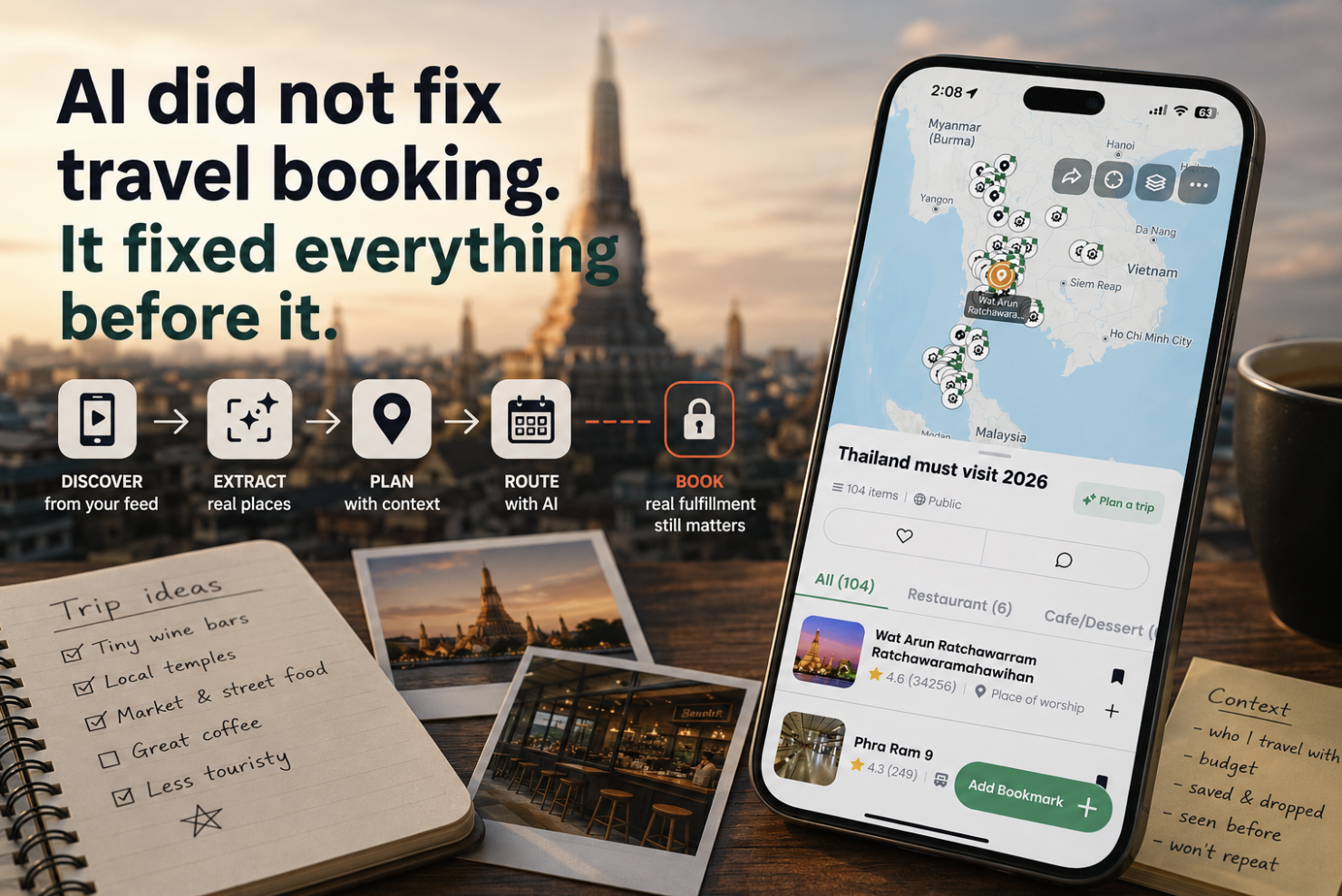
Nobody built for that moment before because it produces the wrong kind of material: a vertical video with a voice-over, a screenshot of someone else's screenshot, a name spoken once and never spelled. Reading it required a human. That is the actual unlock. AI made the ambient, pre-intent moment machine readable and converted an episodic category into a habitual one. Nothing about better planning could have done that.
The general version, for anyone outside travel: if your product is only useful during an episode, the episode sets your ceiling. The fix is not a better product for the episode. It is finding the daily behavior that precedes it.
Coverage stopped being a moat
Most durable travel businesses of the last forty years were coverage businesses. Guidebooks, review inventories, city guides, local supply operations: the barrier to entry was the labor of being present in enough places. You won by grinding out one city at a time, and once you had, nobody caught you quickly.
When the input becomes the world's public content, that barrier collapses. Coverage arrives as a byproduct rather than an achievement, and a product built this way is geography agnostic on day one, not because anyone planned an expansion but because its users already watch content from everywhere. That retires the industry's oldest defensive position. Content coverage is now free. Context is not.
Which is why everyone is converging on the middle
Social platforms are pushing down-funnel, making the stays and experiences inside travel videos directly bookable. Booking platforms are pushing up-funnel, building inspiration feeds and assistants. They are not drifting toward each other by accident. They are reaching for the same asset, and it is neither content nor inventory.
The feed knows what you watched. The booking platform knows what you paid. Remarkably little in this industry knows what you are trying to do: who you are traveling with, what you saved and quietly dropped, what you can spend, what you will not repeat. That layer is the contested territory of the next few years, and it is the one thing here you cannot buy. It accumulates one traveler at a time.
What AI did not change: fulfillment
The most informative travel story of the year was not reported as a travel story. In March, OpenAI walked back its plan to handle checkout directly inside ChatGPT, routing bookings out to established travel platforms and keeping ChatGPT in discovery. Booking and Expedia shares rose roughly ten percent, which tells you how the market read it.
Two things were happening at once. On the supply side, payments, customer service, and fulfillment at travel scale are a genuinely different business from answering questions well. On the demand side, and this should unsettle anyone building here, people were glad to ask for ideas but left when it was time to enter a card. Trust for recommendation and trust for transaction are not the same trust.
Intent generation and fulfillment have completely different cost curves, and AI bent only one of them. Generating qualified intent is now close to free. Fulfilling it costs what it did five years ago: real payments, inventory truth, cancellation windows, refunds, chargebacks, taxes due at the property rather than at checkout, someone answering at two in the morning in a timezone you do not operate in. Little of that is a model problem. Most of it is a liability problem, and liability does not compress.
So the honest prediction is not that agents will book your trips. It is that they will produce more qualified intent than this industry has ever had to absorb, against a fulfillment capacity that did not grow. When demand generation stops being the constraint, margin follows the constraint to demand absorption. Intent without fulfillment is a lead generation business, which is a real business but a much smaller one than the decks imply.
What AI also did not change: taste is not specifiable in advance
Agent design tends to assume the user knows what they want and needs a better interface for saying it. Travel disproves this daily. Travelers cannot state their constraints up front. They recognize them when they see a draft: too much walking on day two, three temples when they wanted one, an evening with no room to be bored.
The consequence is concrete. For decisions driven by taste rather than optimization, the right output is a fast, revisable draft, not a confident final answer. The confident answer is worse than useless, because it hands the burden of articulation back to someone who cannot articulate. Optimize for how cheap it is to change the answer, not how impressive the first one looks. This is not travel-specific. It applies to every agent sitting in front of a decision whose preferences are only legible in hindsight.
Three second-order effects
Supply-side aggregation is no longer defensible. The marketplace instinct is to lock up supply first. In travel content the supply already exists publicly, at a scale no company could commission, for free. Recruiting creators to produce more of it, absent demand, rebuilds an inventory that is already there. The scarce act is structuring it and attaching it to someone actually going somewhere.
Paid acquisition became a diagnostic rather than a skill. Where the product is cheap to copy, acquisition cost moves when the product changes, not when the creative does. Treat it as an instrument reading. And be suspicious in the other direction: ad platforms optimize toward whatever proxy you hand them, and cheap installs are the easiest proxy to over-optimize into users who never come back.
Creator partnerships shift from awareness to attributed conversion. Travel creators were paid for reach because reach was the only measurable thing. Once a save, a plan, and a booking trace back to a specific piece of content, the deal structure changes, and so does which creators are worth paying. Reach and conversion are not the same population.
What this adds up to
Within a year, AI itinerary generation will be table stakes everywhere and roughly equally good, because it is the same handful of models underneath. Nobody wins on it. Differentiation moves to two places: the accumulated context that makes a plan personal, and the operational depth to carry that plan through to something booked, paid for, and supported when it goes wrong.
The question for the next two years is not which system plans a better trip. It is which product earns its way into the moment before the trip exists, and whether it can carry that intent all the way through to the part nobody enjoys building.
Frequently asked questions
Why do travel apps have such low retention compared to other consumer apps?
Because travel is episodic. Most travelers take a small number of trips per year, so a product that is only useful during a trip is competing for a rare moment, and its retention curve reflects the trip calendar rather than the quality of the product. The low retention band that travel apps are usually benchmarked against is best understood as a property of that usage window, not a ceiling on the category. Products that attach to a behavior happening in the long gaps between trips, such as watching travel content, are measured on a different curve entirely.
Did OpenAI stop supporting travel bookings in ChatGPT?
In March 2026, OpenAI walked back its plan to complete travel checkout directly inside ChatGPT and instead routes booking to established travel platforms, keeping ChatGPT positioned in discovery. Shares in major online travel agencies rose sharply on the news. Two forces drove the decision: fulfilling travel transactions involves payments, inventory accuracy, cancellations, refunds, and customer support at a scale that is a different business from answering questions, and consumers who were happy to ask for recommendations were reluctant to enter payment details in that context.
Will AI agents replace online travel agencies?
The evidence so far points to a split rather than a replacement. AI systems have made generating qualified travel intent close to free and effectively unlimited, but they have not reduced the cost of fulfilling a booking, which still requires payment infrastructure, live inventory, cancellation handling, refunds, and support staff. When demand generation stops being the constraint, value concentrates in whoever can absorb that demand operationally. The likely outcome is that agents produce far more intent than the industry has ever handled, and existing fulfillment operators capture much of it unless a new entrant takes on the same operational burden.
What is the difference between traveler intent and travel content?
Travel content is the material that inspires a trip, such as videos, articles, photos, and reviews, and it now exists in effectively unlimited supply on public platforms. Traveler intent is the specific situation of one person: where they are going, who they are traveling with, what they have already saved or ruled out, what they can spend, and what they have already seen. Content has become abundant and cheap to obtain, while intent is scarce, accumulates slowly through repeated use, and cannot be acquired in bulk. That asymmetry is why social platforms and booking platforms are both moving toward the middle of the funnel.
Why do AI trip planners still ask users to review and edit the itinerary?
Because travel preferences are usually not specifiable in advance. Travelers often cannot state their real constraints up front, and instead recognize them when they see a concrete plan, noticing only then that a day involves too much walking or that an evening is overscheduled. For decisions driven by taste rather than by optimization, the most useful output is a fast draft that is cheap to revise, not a confident final answer. Keeping a person in the loop is a design response to how preferences actually surface, not a sign that the underlying models are weak.
Explore on DocentPro




Back to all articles