
Amsterdam's Liquid Embrace: A Scenic Cruise Through the City of Canals

Walking Tour

2.5 km (1.6 miles)

35 min travel time

9 Stops

Amsterdam, Netherlands
Amsterdam's Liquid Embrace: A Scenic Cruise Through the City of Canals

9 places on the map
Explore the map in the DocentPro app
Tour Stops
1
Damrak
View on map
Audio Narrations
English
Introduction
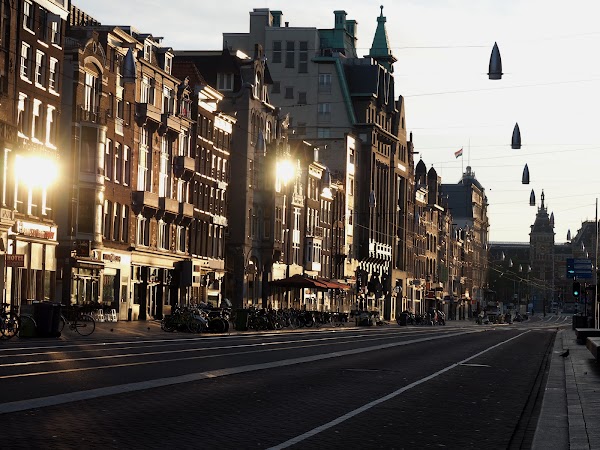
Damrak, the historical canal-turned-avenue in Amsterdam, Noord-Holland, Netherlands, once served as the bustling primary harbor of the city. Its unique concave sweep, framed by towering, narrow 17th-century merchant houses, reflects its maritime past, where ships unloaded directly onto its quays. Beneath the present-day Damrak lies the buried Amstel River, a silent testament to the city's continuous expansion and land reclamation efforts. The street is famously punctuated by the Beurs van Berlage, a monumental brick edifice by Hendrik Petrus Berlage, which stands as a masterpiece of Dutch rationalist architecture, originally conceived as a commodity exchange. While much of the Damrak was filled in the late 19th century to create the street we see today, a small section near Centraal Station retains its open water, adorned with charming houseboats and tour boats, offering a glimpse into its former watery expanse. This remaining water body, often overlooked, subtly preserves the area's original character.Historical Urban Development
The Damrak in Amsterdam, part of a city deeply shaped by historical urban development, traces its origins to the 13th century. Amsterdam itself began with a dam on the Amstel River, aptly named Amestelledamme, between 1264 and 1275, a pivotal moment that fostered the growth of a settlement focused on traffic, production, and trade rather than agriculture. This early dam effectively connected the Amstel to the wider waterways of the IJ estuary, formed dramatically by the All Saints' Flood of 1170. This natural event transformed a shallow river into a significant junction for international trade, making the downstream Amstel mouth attractive for permanent habitation. The construction of canals in Amsterdam, starting in 1613, expanded the city's infrastructure from west to east, although the eastern part of this concentric plan was never fully realized. Over centuries, some canals, like the Nieuwezijds Voorburgwal and the Spui, were filled in and converted into streets or squares, illustrating the city's evolving urban fabric. Post-19th century, Amsterdam experienced further planned expansion. Samuel Sarphati's mid-19th-century vision, inspired by Paris and London, aimed at improving public health and resulted in significant public buildings. Following this, civil engineers Jacobus van Niftrik and Jan Kalff developed a ring of 19th-century neighborhoods around the city center, primarily for the working class, with the city retaining land ownership to control development. Early 20th-century plans, such as Plan Zuid and West, addressed overcrowding by creating new housing blocks for all social classes. Post-World War II, large new neighborhoods like the Westelijke Tuinsteden and the Bijlmer emerged in the city's west, southeast, and north, providing affordable housing with modern amenities amidst green spaces. This continuous transformation reflects Amsterdam's long history of adapting its urban landscape to changing needs and opportunities.Photographic Documentation
For photographic documentation, Damrak in Amsterdam offers a unique study in evolving urban landscapes and historical preservation through its visual record. Early daguerreotypes and albumen prints from the mid-19th century capture Damrak's bustling maritime activity, showcasing the dense forest of ship masts and the integrated canal-side commerce. These images provide invaluable insight into the pre-landfill configuration of the area, contrasting sharply with its present-day state. Later photographic series, particularly those documenting the extensive infill projects of the late 19th and early 20th centuries, are crucial for understanding the urban planning decisions that transformed the waterway into a broad avenue. These sequential photographs often highlight the architectural demolition and construction phases, illustrating the shift from water-based logistics to rail and road infrastructure, and the subsequent emergence of the prominent mercantile buildings that define its current appearance. Aerial photography, beginning in the mid-20th century, adds another layer of documentation, offering panoramic views of Damrak's integration into the broader city fabric and its role as a major thoroughfare leading to Centraal Station. Contemporary photographic documentation, including digital archives and street-level imagery, continues to record the dynamic interplay of its historic facades with modern commercial signage and pedestrian flow. The systematic compilation of these diverse photographic materials allows for a comprehensive visual narrative of Damrak's morphological transformation, providing a rich resource for architectural historians, urban planners, and sociologists interested in the visual evidence of urban change. The persistent photographic gaze upon Damrak underscores its status as a critical artery of Amsterdam, perpetually adapting and perpetually documented.
2

BODY WORLDS Amsterdam
View on map
Audio Narrations
English
Introduction
BODY WORLDS Amsterdam, a captivating exhibition, unveils the intricacies of the human body through over 200 real, plastinated specimens. This extraordinary display delves into the profound connection between happiness and health, exploring how our emotions impact our physical well-being. Visitors embark on a seven-level journey, witnessing the body's resilience, vulnerability, and the profound influence of happiness on its functions. The exhibition highlights the groundbreaking plastination technique pioneered by Dr. Gunther von Hagens, preserving human bodies for scientific study and education. BODY WORLDS Amsterdam offers a unique perspective on anatomy, showcasing the body's intricate systems and the profound impact of our choices on our health and happiness.Unique Perspective
BODY WORLDS Amsterdam, a captivating exhibition, offers a unique perspective on human anatomy through the lens of plastinated bodies. This innovative technique, pioneered by Dr. Gunther von Hagens, preserves real human bodies, allowing visitors to witness the intricate details of our physical form. The exhibition delves into the profound impact of emotions and lifestyle choices on our bodies, exploring the interplay between happiness and health. With over 200 specimens on display, BODY WORLDS Amsterdam provides an unparalleled opportunity to study human anatomy in a thought-provoking and immersive setting. The exhibition challenges conventional perceptions of the body, inviting visitors to contemplate the fragility and resilience of the human form. Through its unique approach, BODY WORLDS Amsterdam fosters a deeper understanding of our own bodies and the importance of cherishing our health and well-being.Educational Value
BODY WORLDS Amsterdam offers an unparalleled educational experience, delving into the intricate workings of the human body through the fascinating medium of real, preserved specimens. This unique exhibition showcases over 200 anatomical models, providing an up-close and personal exploration of human anatomy. Visitors can witness the remarkable resilience and complexity of the human form, gaining a deeper understanding of its strengths, vulnerabilities, and defense mechanisms. BODY WORLDS Amsterdam goes beyond mere observation, inviting visitors to engage with interactive displays that allow them to measure their own blood pressure and undergo a full-body scan and weight analysis. These interactive elements reinforce the educational value of the exhibition, making the concepts of health and anatomy relatable and tangible. The museum's focus on the theme of happiness adds a unique dimension, exploring the anatomical effects of emotions and well-being. By examining the interplay between physical and mental health, BODY WORLDS Amsterdam provides a comprehensive and thought-provoking educational experience that extends beyond the traditional boundaries of anatomy.
3

Westerkerk
View on map
4

Homomonument
View on map
5

Prinsengracht
View on map
6

Negen Straatjes
View on map
7

Museum of the Canals
View on map
8

De Krijtberg
View on map
9

Torture Museum
View on map
Experience the Full Tour
Download the DocentPro app to access all tour stops, complete audio narrations in multiple languages, offline maps, and interactive features.